Showing posts with label suzuki. Show all posts
Showing posts with label suzuki. Show all posts
Saturday, June 1, 2013
Suzuki Boulevard S40 Replacement Powersports Oil Filters
This my article about oil filtering suzuki, if you have problem for repair motorcycle and you will search intruction about Suzuki Boulevard S40 Replacement Powersports Oil Filters you can read or download file below:
Read more »
- Outstanding Oil Filtration
- High Oil Flow Rate
- Heavy Duty Construction
- Great with Synthetic or Conventional Oil
- Traps 99% of harmful contaminants
Get file manual here

2006 suzuki boulevard s40 specs
There´s a just right cause so many highway bikes within the ´50s and
´60s were big single-cylinder computing devices: they´re extremely fun
to ride! The Boulevard S40 adds a shot of evolved Suzuki technology to
this timeless design to create a bike that mixes exciting performance
with rock-solid reliability. Discussions for each bike

Bikez has dialogue discussion boards for every bike. View feedback, questions and solutions at the 2006 Suzuki Boulevard S40 discussion workforce. You can join electronic mail notifications when different riders solution you. If you will have in depth experience with the MC, please ship us a evaluate.
If you believe buying this bike, you must view the listing of associated motorbikes Look at photos. Compare technical specs. And check out the rating of the bike's engine efficiency, reliability, repair costs, etc. You can compare the ranking with other bikes.
For specs and manual download here
Read more »
Bikez has dialogue discussion boards for every bike. View feedback, questions and solutions at the 2006 Suzuki Boulevard S40 discussion workforce. You can join electronic mail notifications when different riders solution you. If you will have in depth experience with the MC, please ship us a evaluate.
If you believe buying this bike, you must view the listing of associated motorbikes Look at photos. Compare technical specs. And check out the rating of the bike's engine efficiency, reliability, repair costs, etc. You can compare the ranking with other bikes.
For specs and manual download here
Tuesday, May 14, 2013
2013 Suzuki RM Z450 and RM Z250 Specifications

2013 RM-Z450 Specifications
ENGINE
- Engine : 449cc, 4-stroke, liquid-cooled, single cylinder, DOHC
- Bore Stroke : 96.0mm (3.8 in) x 62.1mm (2.4 in)
- Compression Ratio : 12.5:1
- Fuel System : Fuel Injection
- Starter Primary kick
- Lubrication : Semi-dry sump
- Ignition : Electronic ignition (CDI)
CHASSIS
- Overall Length : 2190 mm (86.2 in)
- Overall Width : 830 mm (32.7 in)
- Overall Height : 1270 mm (50.0 in)
- Wheelbase : 1495 mm (58.9 in)
- Ground Clearance : 325 mm (12.8 in)
- Seat Height : 955 mm (37.6 in)
- Curb Weight : 113 kg (249 lbs)
- Transmission : 5-speed constant mesh
- Final Drive : Chain, DID520MXV4, 114 links
- Suspension Front : Inverted telescopic, coil spring, oil damped
- Suspension Rear : Link type, coil spring, oil damped
- Brakes Front : Disc brake
- Brakes Rear : Disc brake
- Tires Front : 80/100-21 51M, tube type
- Tires Rear : 110/90-19 62M, tube type
- Fuel Tank Capacity : 6.2 L (1.6 US gallons)
- Color : Champion Yellow

2013 RM-Z250 Specifications
ENGINE
- Engine : 249cc, 4-stroke, liquid-cooled, single cylinder, DOHC
- Bore Stroke : 77.0mm (3.0 in) x 53.6mm (2.1 in)
- Compression Ratio : 13.5:1
- Fuel System : Fuel Injection
- Starter : Primary kick
- Lubrication : Semi-dry sump
- Ignition : Electronic ignition (CDI)
CHASSIS
- Overall Length : 2170 mm (85.4 in)
- Overall Width : 830 mm (32.7 in)
- Overall Height : 1270 mm (50.0 in)
- Wheelbase : 1475 mm (58.1 in)
- Ground Clearance : 345 mm (13.6 in)
- Seat Height : 955 mm (37.6 in)
- Curb Weight : 106.5 kg (235 lbs)
- Transmission : 5-speed constant mesh
- Final Drive : Chain, DID520DMA4, 114 links
- Suspension Front : Inverted telescopic, coil spring, oil damped
- Suspension Rear : Link type, coil spring, oil damped
- Brakes Front : Disc brake
- Brakes Rear : Disc brake
- Tires Front : 80/100-21 51M, tube type
- Tires Rear : 100/90-19 57M, tube type
- Fuel Tank Capacity : 6.5 L (1.7 US gallons)
- Color : Champion Yellow
Saturday, May 11, 2013
The Edgy and Distinctive SUZUKI Katana


You have heard about the SUZUKI STRATOSPHERE right? Yes, it is a prototype but the 184 hp 1180cc in-line 6 is coming up this year. And you also know that it’s a decedent of the hallowed SUZUKI KATANA. What is that about the Katana that Suzuki has modeled their most ambitious project on it?
The Katana began its life in 1980 made it to world production in 1982 and was last produced in 2006. There were various models from 250cc, 400cc, 650cc, 750cc, 1000cc and 1100cc. However, it was the 750 and above bikes which gained prominence for it’s in line 6 cylinder engines. Not many production houses have history of 6 cylinder bikes, the ones that readily come in mind are of course Honda’s CBX and Goldwing and Benelli’s Sei. The first or let’s say, ‘original’ Katana was designed by a firm named Target Design. Target Design hails from Germany and is still active. They were approached by the native Suzuki firm to design a locale specific bike. There are lots of stories there as to who had actually designed the bike, all of them part of the team of Target Design at one time or another.
These were designed with the sports touring concept and critics were skeptical about its appearance although it turned out to be a huge success. Later it also was manufactured in America and it turned out to be a huge success story there too.
The Katana began its life in 1980 made it to world production in 1982 and was last produced in 2006. There were various models from 250cc, 400cc, 650cc, 750cc, 1000cc and 1100cc. However, it was the 750 and above bikes which gained prominence for it’s in line 6 cylinder engines. Not many production houses have history of 6 cylinder bikes, the ones that readily come in mind are of course Honda’s CBX and Goldwing and Benelli’s Sei. The first or let’s say, ‘original’ Katana was designed by a firm named Target Design. Target Design hails from Germany and is still active. They were approached by the native Suzuki firm to design a locale specific bike. There are lots of stories there as to who had actually designed the bike, all of them part of the team of Target Design at one time or another.
These were designed with the sports touring concept and critics were skeptical about its appearance although it turned out to be a huge success. Later it also was manufactured in America and it turned out to be a huge success story there too.

The word Katana means sword in Japanese and its distinctive appearance is the curved, slender, single edged blade with a long grip to accommodate two hands. This original design was a 650 cc model called the ED-1 (European Design 1) which featured a forward nose and a shaped, blended fuel tank with a merged fuel tank-to-seat arrangement. It was so out of style or to put it, so out of time. Norms at that time were of course the flat rectangular tanks with bolt-on accessory fairings so the new design was probably a risk the designers were willing to take and also deep down knew that it would stand out. The other thing was that the design was for a reason, to favour the aerodynamics and after various wind tunnel testing, it proved to aid stability during high-speed. If you search the net, you will find a similar design on a prototype MV Agusta which never got into production. Ironically, even that model was designed by Target Design. In fact when it was launched in Cologne in 1980, most people thought it was a concept motorcycle which would not make it to production. But Suzuki released the bike as per the showcased model with additional improvements and changes here and there. Target Design had apparently spent a lot of time on the bike finding the suitable position which is most essential for touring bikes. The large capacity tank blended with the small fairing blended together for the best airflow were not just for stunning appearance.But just being supremely aerodynamic doesn’t mean that Suzuki is going to revive the design after in their prototype Stratosphere. The Katana was the fastest mass-production motorcycle in the world when it was launched which meant that the new looks were matched by unprecedented performance levels.


In the same year of ED-1, came the ED-2 at the Cologne Motor show and this time it had a much bigger engine, the 1100 cc model which was based on the Suzuki GS1000. In 1981, came out the actual design which hailed the ‘Katana’ looks from there on. It had everything. And that was the start of a new definition in biking as the ’Katana’ became immensely popular all over. The offset petrol filler cap from the tank’s centerline, those overlapping dials on the instrument panel and literally everything became a style statement.
There were also other versions as mentioned, like the 750cc and a 1000cc, all were basically carrying the exact traits of the 650 or the 1100 version. The 1000 cc version was promoted as a racing motorcycle.
Actually it’s not just the Stratosphere that Suzuki has got the genes of the Katana incorporated to, the hallowed GSK-R series is also a descendent of the Katana. And of course indirect descendents too like the GSX-F and GSX-E series.
The various models of the series comprised of five basic models GSX600F and GSX750F that came out between 1988 – 1997 which were reincarnated in newer styles from 1998 – 2006 and between 1988 - 1993 came the GSX1100F. There models were mainly for the U.S market. The same GSX-F models were also running in Europe but without the ‘Katana’ moniker. Moreover the name Katana came into the existence of European customers of Suzuki in 1999 through a couple of 50cc scooters! Now the design has reappeared in the form of the Stratosphere which made its debut at the 2005 Tokyo Motorcycle Show with a new transversely-mounted narrow 6-cylinder engine.
There were also other versions as mentioned, like the 750cc and a 1000cc, all were basically carrying the exact traits of the 650 or the 1100 version. The 1000 cc version was promoted as a racing motorcycle.
Actually it’s not just the Stratosphere that Suzuki has got the genes of the Katana incorporated to, the hallowed GSK-R series is also a descendent of the Katana. And of course indirect descendents too like the GSX-F and GSX-E series.
The various models of the series comprised of five basic models GSX600F and GSX750F that came out between 1988 – 1997 which were reincarnated in newer styles from 1998 – 2006 and between 1988 - 1993 came the GSX1100F. There models were mainly for the U.S market. The same GSX-F models were also running in Europe but without the ‘Katana’ moniker. Moreover the name Katana came into the existence of European customers of Suzuki in 1999 through a couple of 50cc scooters! Now the design has reappeared in the form of the Stratosphere which made its debut at the 2005 Tokyo Motorcycle Show with a new transversely-mounted narrow 6-cylinder engine.

The Katana series of bikes had round slide carburetors as opposed to the CV types and hotter camshaft timing to allow for a lack of cubic capacity. There came a special 1100 cc variant, the E27 that was denoted by the suffix SXZ which had variations on the brakes, clutch, camshafts, had spoked wire wheels and slide carburetors that have become a collector’s item now because it had even more power than the standard 1100 cc model. The smaller versions of 250cc and 400cc were released in 1990 but they catered to only the Japanese market as Japan still now has a huge market in sub 500cc naked street motorcycles. The thing was that Suzuki was always reinventing the Katana series with minor or effective changes and they did that to the entire bigger fleet of bikes. Even the 1100 cc was reintroduced with very minor differences from the originals, even running early 80s narrow tyres. There was a Special Edition 750 cc version, the Katana 750SE with a pop-up headlight. These bikes over time… and probably Suzuki wanted it that way… whatever the reason was, the engines stayed the same and all those variations were only physical. After the 650, came the 1100 and then came the 750 cc intermediate brother wearing all of big brother’s clothes.

The 1981 GSX750SX and 1982 GSX750SD were identical except for the colors. Again for Japan only, there was a GSX750S which was without a windscreen and the one with a screen was called SS. Then there was the GSX750S Katana Mark 2 model released in 1983 which was longer, wider and higher than the original but shared the same wheelbase. The 750 series has power outings of 69 bhp initially followed by 72 bhp in the 1983 model and later models had 77 bhp.But in 1985, GSX750SE got a completely new model, not just a facelift. It was designed by Suzuki engineers in Japan but it still kept the original ‘Katana’ lines. The air cooled engine had been replaced by the new oil-cooled 16-valve unit from the GSX750E/ES/EF, and developed 90 bhp. It had the Suzuki Full Floater suspension rear end and Positive Damping Forks at the front. 1985 was the last year of the GSX750S. Only cosmetic changes were made, the gold paint had been used only for the wheels. The model was very short-lived. For domestic market in Japan, the model code was GSX750S-4, GSX750SF in Europe. But the engine makeovers were minimal. So the hottest bike of the early 80s in terms of performance were slowly getting beaten by smaller bikes at we entered the 90s, but Suzuki was not perturbed as the Katana lovers adored it more for its radical styling which still today can be said as very different from what you see normally. But critics ripped apart Suzuki. And not only critics, there were many Katana lovers too.
You see, from the meaning of the work to the original motorbike, Katana represented a ‘fast lethal devastating’ kind of a bike which by the 90s became associated with slow heavy and dated sports tourer. And not to mention the scooter series in Europe. In terms of performance, the later models saw substantial rise in power to as much as 100hp in the 750 version from 84 hp but at the same time there were bikes in the 600 category which were running with 130 and more horses. If Suzuki kept up with the engine with the times, Katana might just have been one of the biggest names in Motorcycling history. But that was not to be and the ‘original’ Katana was lost forever… or probably not as speculations say that the Stratosphere will just have Busas for breakfast before moving on to ZX-14R and the likes.Katana for Suzuki became more of a styling icon. Many of the Katana styling cues have been visible in other brands since the 80s. Even today, you find features of the Katana in so many bikes, especially the sports touring category. The fact that modern sport motorcycles generally have fairing and seats that visually merge into a sloping-at-the-rear fuel tank is directly traceable to the original Katana ED1/ED2 design series.


2005 GSX 750F
Engine - 750cc, Air/oil cooled four stroke, transverse four cylinder, DOHC, 4 valves per cylinder
Bore x Stroke - 70 x 48. mm
Compression Ratio - 10.7:1
Induction - 4 x 36mm Mikuni BSR36SS
Ignition / Starting - Digital / electric
Max Power & Torque - 100 hp 72.9 kW @ 10500 rpm & 73.5 Nm @ 9500 rpm
Transmission / Drive - 6 Speed / chain Front Suspension - 41mm forks adjustable for rebound and preload, 130mm wheel travel.
Rear Suspension - Monoshock adjustable for Preload, compression & rebound, 142mm wheel travel.
Front & Rear Brakes - 2x 290mm discs 2 piston caliper & Single 240mm disc 2 piston caliper
Front & Rear Tyre - 120/70 ZR17 & 150/70 ZR17
Dry Weight - 201 kg
Fuel Capacity - 20 Litres
Consumption average – 18.8 kmpl
Top Speed 143 mph
1992 GSX 1100F (US Katana)
Engine - 1127cc, Air/oil cooled, four stroke, transverse four cylinder, DOHC, 4 valve per cylinder
Bore x Stroke - 78 x 59 mm
Compression Ratio - 10.0:1
Induction - 4x 34mm Mikuni CV
Ignition / Starting - Electronic ignition / electric
Max Power & Torque - 136 hp 99.1 kW @ 10000 rpm & 112 Nm @ 7000 rpm
Transmission / Drive - 5 Speed / chain
Front Suspension - Telescopic, oil damped, spring preload fully adjustable
Rear Suspension - Full Floater rising-rate monoshock, 5-way preload and 4 way damping adjustable
Front & Rear Brakes - 2x 275mm discs 2 piston calipers & Single 275mm disc 2 piston caliper
Front & Rear Tyres - 120/80 V16 & 150/80 V16
Dry & Wet Weight - 244 kg / 256 kg
Fuel Capacity - 21 Litres
Consumption average - 14.6 kmpl
Top Speed - 251.3 km/h


The upcoming STRATOSPHERE and the original KATANA
The following pictures below have been sent by DOUBLE OH TWO, a fellow blogger who has a lot of beautiful collection of images of bikes and other stuff. Check it out! You will probably like it.The photos appear in the blog Diary of a Grey Ghost.
2012 Suzuki Hayabusa
Suzuki Hayabusa simply is not for everyone. With reference to the performance that established it as the most exciting sport bike on the planet, it is designed for serious cyclists will accept nothing less than the best. If this is you, and if you choose to ride Hayabusa, you will be rewarded with a driving experience you will never forget. Its unmatched combination of power, crisp handling and aerodynamics of the bike creates a superb sports ultimate.
 |
| 2012 Suzuki Hayabusa |
For 2012, the Hayabusa is available with new graphics and colors - Black Sparkle Glass Pearl and Glacier White.
Specifications
Engine
Displacement 1340cc, 4-stroke, Liquid-cooled, 4-cylinder, DOHC
Fuel System Suzuki fuel injection
Starter Electric
Ignition Electronic ignition (transistorized)
Chassis
Overall Length 2190 mm (86.2 in)
Overall Width 735 mm (28.9 in)
Wheelbase 1480 mm (58.3 in)
Ground Clearance 120 mm (4.7 in)
Seat Height 805 mm (31.7 in)
Curb Weight 260 kg (573 lbs)
Transmission 6-speed constant mesh
Final Drive Chain, RK GB50GSV Z4, 114 links
Suspension Front Inverted telescopic, coil spring, oil damped
Suspension Rear Link type, coil spring, oil damped
Brakes Front Disc brake, twin
Brakes Rear Disc brake
Tires Front 120/70ZR17 M/C (58W), tubeless
Tires Rear 190/50ZR17 M/C (73W), tubeless
Fuel Tank Capacity 21.0 L (5.5 US gallons)
Fuel Tank Capacity CA 20.0 L (5.3 US gallons)
Color Glass Sparkle Black and Pearl Glacier White
Wednesday, May 8, 2013
Suzuki GB 2012

Suzuki GB 2012 marketing manager, George Cheeseman commented, “With the white colour option already proving a very popular choice on other models, we believe that the limited run of 200 white Hayabusas will be extremely popular.
 |
| suzuki gb 2012 |
Suzuki GB 2012 is the new street-bike motorcycles from Suzuki GB 2012 this bike reportedly will available in 2012. As reportedly from Suzuki GB 2012 UK official website, motorcycles will arrive in the UK in Suzuki GB 2012 .
 |
| suzuki gb 2012 |
Our rider line-up is yet to be announced. However we are confident of having two riders who will be capable of achieving the results we ultimately desire. We also have a few surprises in terms of our sponsorship line-up, which could see our bikes take on a new look for Suzuki GB 2012 . That again will be announced in the coming weeks.
 |
| suzuki gb 2012 |
Suzuki GB 2012 are hosting its first ladies-only track day at Donington Park in Leicestershire on 14 September. All lady riders will be welcomed, regardless of the make of bike they own, to celebrate everything that is great about bikes.
 |
| suzuki gb 2012 |
Suzuki GB 2012 racing director and three times BSB champion, John Reynolds, commented, "Im absolutely delighted to be part of Suzukis first ever ladies track day. Since I retired from racing, I now spend a great deal of my time on-track instructing at various track days.
The 2013 Suzuki Boulevard M109R Limited Edition

This is new generation in cruiser segment from Suzuki’s. The name is 2013 Suzuki Boulevard M109R Limited Edition. This bike is the most powerful cruiser Suzuki has ever produced. It’s also combining sleek classic styling and unparalleled performance. The limited edition features a red body work, black-colored wheels and final gear case, and white lens taillight and turn signals.

The heart packed in 1783 cc (108.8 cu. in) type 4-stroke, 2-cylinder, liquid-cooled, DOHC, 54-degree V-Twin and 5 speed of transmission constant mesh. The engine built to produce a massive tractable power and responsive torque. The big V-twin also produces a throaty, aggressive exhaust that identifies the M109R Limited Edition as a power cruiser beyond compare. The fuel injection used Suzuki Dual Throttle Valve system (SDTV) with 56mm throttle bodies, which maintains optimum air velocity for smooth low to mid-range throttle response. A dual spark plug per cyclinder ignition system is controlled by a powerful 32-bit ECM for improved combustion efficiency and reduced exhaust emissions.
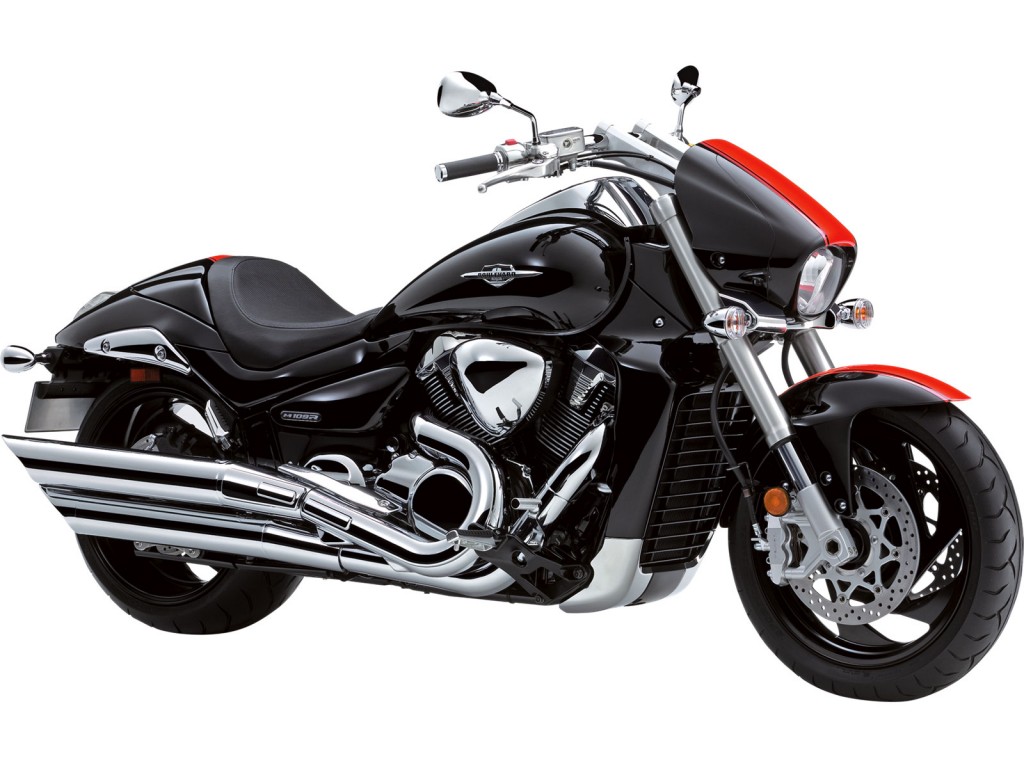
Some special feature from Suzuki’s is pinned in Boulevard M109R Limited Edition such as Suzuki Dual Throttle Valve (SDTV) fuel injection system produces smooth throttle response even at low engine rpm, Suzuki Advanced Sump System (SASS), a compact dry-sump lubrication system, designed for reduced engine height, a lower crankshaft position and lower center of gravity. SCEM (Suzuki Composite Electrochemical Material) for optimum heat transfer, tighter piston-to-cylinder clearances and reduced weight.

For comfortable ridding, the Boulevard M109R Limited Edition used a high-tensile double cradle steel frame. It’s built to confortably handle all the power and torque while delivering agile handling and a plush, smooth ride. For front suspension used inverted front forks feature race-proven cartridge internals with 46mm stanchion tubes. In rear suspension used a cast aluminum alloy swingarm works with a progressive shock linkage and a preload-adjustable single rear shock delivering 4.6 inches of wheel travel.
The 2013 Suzuki Boulevard M109R Limited Edition released in US MSRP Price: $14,799 USD.
Tuesday, May 7, 2013
Suzuki SV1000 Manual

While the faired SV isn't to everyone's sensation - its sporty riding function can put a bit of a sweat on your wrists making it a somatesthesia through town - the overt variant comes with even bars and a comfier and overmuch author upright travel perspective. And suchlike the SV650, this makes it a some advisable townsfolk bike.
Motion on the SV1000, having honorable spent the high period moving around on the unclothed 650, the supererogatory size of the 1000 is now ostensible. Where the 650 virtually doesn't perceive equal a victorian bike because it's so shrimpy and lightweight the 1000 has a lot writer corporeal presence nigh it. It exclusive weights an additional 18kg over the 650 but it feels bigger and chunkier in a reassuring forgiving of way, especially if you are quite long.
The equitation business is slightly statesman pushful than the 650 because of the added situation of the bike. Your legs are pushed slightly advance isolated and the bars feel a bit wider than the 650's, which cooperative with the player weight makes it seem sturdy. Also the pegs are set change than the faired SV1000, swing you in a straight-backed, straight-armed athletics orientation which is actually quite comforted.
Friday, May 3, 2013
2011 Suzuki GSX 1250 FA Review
GSX1250FA Suzuki motorcycle wheel is the demanding, looking for the line-up is too specialized sport bikes or sturdy sport-tourer emphasizes the last part of the title material. In addition to standard anti-lock brakes, GSX1250FA is an element of its construction and built to go anywhere, any time the motor cyclist, who appreciate the versatility of more than an exaggeration.
Stripped of his nickname Bandit 400 Bandit used since the introduction of the United States in 1991, GSX1250FA also differs from its predecessor in terms of full-fairing cosmetics. Updates include less obvious heavier fork springs and rebound stronger, and radiator fan to compensate for the additional loss of air flow total body coverage.
Stripped of his nickname Bandit 400 Bandit used since the introduction of the United States in 1991, GSX1250FA also differs from its predecessor in terms of full-fairing cosmetics. Updates include less obvious heavier fork springs and rebound stronger, and radiator fan to compensate for the additional loss of air flow total body coverage.

GSX1250FA engine is undoubtedly one of the best qualities of the bike. With a maximum torque at a V-Twin (72.3 lb-ft at only 3500), GSX antics out of the corners with a force that contrasts with its modest 92.6 hp at 8800 rpm test figure. The abundance of energy increases low-end real world and ensures ease of use you were never left wanting when running a higher speed or the need to move urgently. Note, however, that the most pleasant and friendly as the fuel injected 1255cc inline-four is given its movement, it is expected that at least one three-digit horsepower numbers.

As capable as the GSX is the cannon, which is the road miles as comfortable as a summary or neighborhood long distance road trips. The ergonomic design is comfortable, with plenty of places to rest your legs and feet for a wide superbike handlebar moderate. The suspension is well balanced on the side of a seat comfort while luxurious. Only in the canyons, brakes and becomes aggressive when the weight of the bike at times exceeds the suspension, but otherwise the bike fork 43 mm and rear shock are only made GSX.

GSX system is the latest ABS motorcycle component technology, but unless an emergency situation is a system that works quietly in the background. I made the pound a couple of times the brakes confirm the existence of the system was more than the front fender stickers. The system sends the familiar feeling pulses through the switches, when activated, but the authority of the wheel stops. Equipped with ABS as standard, GSX1250FA stands out in its category.

Headquarters of the GSX1250FA gives a height adjustment in two positions, changing from 31.7 to 32.5 inches, but the changes on the seat pan to another level is the most complicated processes in the seat height adjustment we have ever met. You want to choose the most appropriate level and leave the seat in this position.
Another subtlety is a pair of helmet locks are located under the seat. I do not know why the producers out of this simple addition to a lot of modern bikes, but I am tired of my helmet is a restaurant, when it would be completely safe, attached to the wheel. Thanks for Suzuki, use common sense, and this feature is also GSX1250FA.
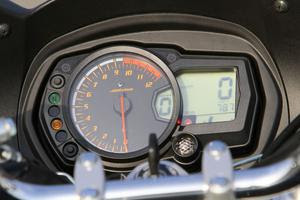
The dashboard is clean and easy to read, and includes a handy digital gear indicator window, another feature absent in similar models.

So if you can swing a test ride at your local retailer, give it a GSX. It is likely to be as pleasantly surprised as we.
Subscribe to:
Posts (Atom)