Tuesday, May 14, 2013
2013 Suzuki RM Z450 and RM Z250 Specifications

2013 RM-Z450 Specifications
ENGINE
- Engine : 449cc, 4-stroke, liquid-cooled, single cylinder, DOHC
- Bore Stroke : 96.0mm (3.8 in) x 62.1mm (2.4 in)
- Compression Ratio : 12.5:1
- Fuel System : Fuel Injection
- Starter Primary kick
- Lubrication : Semi-dry sump
- Ignition : Electronic ignition (CDI)
CHASSIS
- Overall Length : 2190 mm (86.2 in)
- Overall Width : 830 mm (32.7 in)
- Overall Height : 1270 mm (50.0 in)
- Wheelbase : 1495 mm (58.9 in)
- Ground Clearance : 325 mm (12.8 in)
- Seat Height : 955 mm (37.6 in)
- Curb Weight : 113 kg (249 lbs)
- Transmission : 5-speed constant mesh
- Final Drive : Chain, DID520MXV4, 114 links
- Suspension Front : Inverted telescopic, coil spring, oil damped
- Suspension Rear : Link type, coil spring, oil damped
- Brakes Front : Disc brake
- Brakes Rear : Disc brake
- Tires Front : 80/100-21 51M, tube type
- Tires Rear : 110/90-19 62M, tube type
- Fuel Tank Capacity : 6.2 L (1.6 US gallons)
- Color : Champion Yellow

2013 RM-Z250 Specifications
ENGINE
- Engine : 249cc, 4-stroke, liquid-cooled, single cylinder, DOHC
- Bore Stroke : 77.0mm (3.0 in) x 53.6mm (2.1 in)
- Compression Ratio : 13.5:1
- Fuel System : Fuel Injection
- Starter : Primary kick
- Lubrication : Semi-dry sump
- Ignition : Electronic ignition (CDI)
CHASSIS
- Overall Length : 2170 mm (85.4 in)
- Overall Width : 830 mm (32.7 in)
- Overall Height : 1270 mm (50.0 in)
- Wheelbase : 1475 mm (58.1 in)
- Ground Clearance : 345 mm (13.6 in)
- Seat Height : 955 mm (37.6 in)
- Curb Weight : 106.5 kg (235 lbs)
- Transmission : 5-speed constant mesh
- Final Drive : Chain, DID520DMA4, 114 links
- Suspension Front : Inverted telescopic, coil spring, oil damped
- Suspension Rear : Link type, coil spring, oil damped
- Brakes Front : Disc brake
- Brakes Rear : Disc brake
- Tires Front : 80/100-21 51M, tube type
- Tires Rear : 100/90-19 57M, tube type
- Fuel Tank Capacity : 6.5 L (1.7 US gallons)
- Color : Champion Yellow

Saturday, May 11, 2013
The Edgy and Distinctive SUZUKI Katana


The Katana began its life in 1980 made it to world production in 1982 and was last produced in 2006. There were various models from 250cc, 400cc, 650cc, 750cc, 1000cc and 1100cc. However, it was the 750 and above bikes which gained prominence for it’s in line 6 cylinder engines. Not many production houses have history of 6 cylinder bikes, the ones that readily come in mind are of course Honda’s CBX and Goldwing and Benelli’s Sei. The first or let’s say, ‘original’ Katana was designed by a firm named Target Design. Target Design hails from Germany and is still active. They were approached by the native Suzuki firm to design a locale specific bike. There are lots of stories there as to who had actually designed the bike, all of them part of the team of Target Design at one time or another.
These were designed with the sports touring concept and critics were skeptical about its appearance although it turned out to be a huge success. Later it also was manufactured in America and it turned out to be a huge success story there too.


There were also other versions as mentioned, like the 750cc and a 1000cc, all were basically carrying the exact traits of the 650 or the 1100 version. The 1000 cc version was promoted as a racing motorcycle.
Actually it’s not just the Stratosphere that Suzuki has got the genes of the Katana incorporated to, the hallowed GSK-R series is also a descendent of the Katana. And of course indirect descendents too like the GSX-F and GSX-E series.
The various models of the series comprised of five basic models GSX600F and GSX750F that came out between 1988 – 1997 which were reincarnated in newer styles from 1998 – 2006 and between 1988 - 1993 came the GSX1100F. There models were mainly for the U.S market. The same GSX-F models were also running in Europe but without the ‘Katana’ moniker. Moreover the name Katana came into the existence of European customers of Suzuki in 1999 through a couple of 50cc scooters! Now the design has reappeared in the form of the Stratosphere which made its debut at the 2005 Tokyo Motorcycle Show with a new transversely-mounted narrow 6-cylinder engine.


2005 GSX 750F
Engine - 750cc, Air/oil cooled four stroke, transverse four cylinder, DOHC, 4 valves per cylinder
Bore x Stroke - 70 x 48. mm
Compression Ratio - 10.7:1
Induction - 4 x 36mm Mikuni BSR36SS
Ignition / Starting - Digital / electric
Max Power & Torque - 100 hp 72.9 kW @ 10500 rpm & 73.5 Nm @ 9500 rpm
Transmission / Drive - 6 Speed / chain Front Suspension - 41mm forks adjustable for rebound and preload, 130mm wheel travel.
Rear Suspension - Monoshock adjustable for Preload, compression & rebound, 142mm wheel travel.
Front & Rear Brakes - 2x 290mm discs 2 piston caliper & Single 240mm disc 2 piston caliper
Front & Rear Tyre - 120/70 ZR17 & 150/70 ZR17
Dry Weight - 201 kg
Fuel Capacity - 20 Litres
Consumption average – 18.8 kmpl
Top Speed 143 mph
1992 GSX 1100F (US Katana)
Engine - 1127cc, Air/oil cooled, four stroke, transverse four cylinder, DOHC, 4 valve per cylinder
Bore x Stroke - 78 x 59 mm
Compression Ratio - 10.0:1
Induction - 4x 34mm Mikuni CV
Ignition / Starting - Electronic ignition / electric
Max Power & Torque - 136 hp 99.1 kW @ 10000 rpm & 112 Nm @ 7000 rpm
Transmission / Drive - 5 Speed / chain
Front Suspension - Telescopic, oil damped, spring preload fully adjustable
Rear Suspension - Full Floater rising-rate monoshock, 5-way preload and 4 way damping adjustable
Front & Rear Brakes - 2x 275mm discs 2 piston calipers & Single 275mm disc 2 piston caliper
Front & Rear Tyres - 120/80 V16 & 150/80 V16
Dry & Wet Weight - 244 kg / 256 kg
Fuel Capacity - 21 Litres
Consumption average - 14.6 kmpl
Top Speed - 251.3 km/h


Friday, May 10, 2013
Honda Spacy Helm in PGM FI with new stripe and colors

Now, turn the Honda Spacy Helm in PGM-FI get refreshment, with striping and new colors. Refreshing the look of two-tone color combinations. The concept of the latest Honda Spacy Helm stripe in PGM-FI brings sharp lines, sporty, and attractive.
As you know, Honda Spacy Helm in PGM-FI, powered by 110cc PGM-FI engine, of course, fuel-efficient and environmentally friendly. Also Honda Spacy Helm in PGM-FI is the first of a Honda scooter that features a Helm-in.
Honda Spacy Helm in PGM-FI is available in four colors with exciting new stripe, namely Emperor Black, Majestic Red, Imperial White, and Royal Blue. Sold for Rp 13,200,000.
Sunday, May 5, 2013
The Oscars of water sports awarded 2012 YACHT and boats
Two high-profile prizes were awarded on the opening weekend in the watersports-fair boat in 2012. On the traditional industry gathering of Delius Klasing, Europes leading publisher of water sports, and the boot Düsseldorf, the award was for the ninth time "European yacht of the year" award. Initiates the choice is awarded annually by the magazine YACHT. A further international award, awarded for the sixth time under the leadership of Europes largest powerboat magazine from boats is the "European powerboat of the year"
Hamburg/Düsseldorf, 23 January 2012. There are Europes best of the boot sector, which are annually awarded the "Oscar of water sports": in four categories are the international award "European yacht of the year 2012" and the awards to the "European powerboat of the year 2012" in six categories. The jury is composed of the chief editors and test managers of eighteen leading sailing and powerboat magazines of Europe. Traditionally, the boot are awarded two prices on the meeting point of Delius Klasing Verlag and Messe Düsseldorf in the framework. This year, Publisher Konrad Delius and boat project manager Goetz Ulf young who welcomed some 400 guests from the European water sports business to the award ceremony.
Every year nearly 100 new boats on the market come in Europe. But only four shipyards may 2012 about the award "European yacht of the year" look. "The tests in IJmuiden / Holland and Barcelona were characterized by very strong winds this year." On the North Sea, we had over 50 nodes and 4 metres high waves in gusts. But also off the Catalan coast, it blew with well 6 Beaufort, came a chaotic sea. Never before, we had more wind. "A real acid test for the boats, the all good, some also outstandingly well advanced", as in YACHT Chief Jochen Rieker. "Basically you can determine also that consistently more emphasis is placed on good sailing performance." Not only the winner yachts, everyone else made fun at sea. "On the other hand is very consistently developed, unless a total great vintage towards comfort as the ride boats of category family Cruiser, or towards speed and fun, like the performance Cruisern and the special yachts-", so Riekers summary.
Were nominated in the category of Family Cruiser : Bénéteau oceanis 45, Dufour 445 Grandlarge, Elan 210, Jeanneau Sun Odyssey 379, RM 1060. "European yacht of the year" in the category of family cruiser was: Oceanis 45 (Bénéteau)
Were nominated in the category of Luxury Cruiser : Amel 64, Bénéteau sense 50, best wind 50, 64 Hallberg-Rassy, Oyster 625. "European yacht of the year" in the category of luxury cruiser was: Oyster 625 (oyster marine)
In the category of Performance Cruiser were nominated: Dehler 41, Grand Soleil 50, J 111, Pogo 12.50, XP-44. "European yacht of the year" in the category of performance cruiser was: Pogo 12.50 (Pogo structures)
Were nominated in the category of special yachts : Dinamica RS 940, Eagle 44, esse 750, Keus 22, Tarac 33. "European yacht of the year" in the category special was yachts: hood 750 (Josef Schuchters pleasure craft AG)
At least as exciting was the procurement of prices to the "European powerboat of the year 2012" for motor boats. The jury consists of the editors-in-Chief of the seven leading European powerboat magazine from Norway, Italy, France, Netherlands, Switzerland, Austria and Germany. The jury nominated first 25 new products in five categories. More than 200 new boats on the market appear each year. While the agreement this comparatively unanimously ran in the minor class to 25 foot boat length, the many boat premieres in the 35-foot class gave rise to the discussion. Because almost any large shipyard has added in this segment. The middle class is dominated by Northern European news of Britain, Sweden and Germany to Poland in 2012. In the "King class", Italy, France and the United Kingdom continue to specify the sound. In the positive displacement class dominated traditionally by the Netherlands, the Polish shipyard Delphia was nominated for the first time. Also 2012, the motorboat jury has awarded an innovation award again.
In the class, sport boats up to 25 feet were nominated: XO 240 RS cabin, Galia 670 MC, four Winns S215, Sea Ray 210 Overnighter, Yamarin 53 cross center console. "European Powerboat of the Year" in the class up to 25 feet was: Four Winns S215
In the class, sport boats up to 35 feet were nominated: windy 31 Zonda, Jeanneau Merry Fisher 855, Viksund 335 St. Cruz, Frauscher 1017 GT, Cranchi endurance of 30.
"European Powerboat of the Year" in the class up to 35 feet was: Cranchi endurance of 30
Sport boats up to 45 feet were nominated in the category: Nimbus 365 Coupé, Galeon 420 fly, Princess V 39, Bavaria 43 HT, Sealine SC42. "European Powerboat of the Year" in the class up to 45 feet was: 365 Nimbus Coupé
Yachts over 45 foot were nominated in the category: Jeanneau 500 prestige fly, Sessa 45 fly, Bénéteau flyer 49 fly, Sunseeker 53 Manhattan, Azimut 45 fly. "European Powerboat of the Year" was over 45 feet in the class: 500 Jeanneau prestige fly
In the Positive displacement class were nominated: Linssen Range Cruiser 450 sedan Bruijs coaster 1400 open cockpit, Delphia 1350 escape, BC 42 retro line, Adagio 58 Europe. "European Powerboat of the Year" in the positive displacement class was: Bruijs Coaster 1400 Open Cockpit
The innovation award went to the goldfish 23eFusionthis year. In this category, all innovative products in the boating industry of last year were assessed and evaluated. "The Norwegian outboard electric boat with 47 knots maximum velocity and 45 nautical miles range combines the advantages of a modern electric drive with the performance of a conventional speed boat," the professional jury headed by Torsten Moench, editor in Chief of boats from the Delius Klasing Verlag.
Detailed information about all the winners read in the current editions of the magazine YACHT 4/2012 (from 1 February in the trade) and boats 3/2012 (22 February in the trade).
Honda MegaPro review with new body color and stripe

PT Astra Honda Move (AHM) to communicate a new examine at the Honda MegaPro with a new embody change kind and making it examine much handsome, sporty and masculine. Refreshing the sight to alter the mart attack of Honda Causative feature broad.
By decoration, Honda brought the concept of Street Protector MegaPro with a alcoholic attribute and sporty embody and a lancelike illustration ornamentation and luxury, thereby gift the concavity of macho and alone. Changes in embody material kind and create the perception of Honda MegaPro be more doughty and masculine piece maintaining the thought of a swish and unproblematic finished the use of person compositions are defined by nervy and rugged.

Honda MegaPro that since Honorable 2010 has been equipped with engines XRP (X-tra Tractable Show Engine) 150cc4 capacity-Tak, SOHC, 5-speed, air-cooled, which is known to hump a becalm speedup, susceptible and right yet fuel-efficient and environmentally agreeable due to cope Euro-2 expelling standards. In element, the Honda engine XRP MegaPro also been utilized as Low Sweat Parts: Composer Rough Opencast, Wave Teenager Instrumentality and Mien Crankshaft, which serves to confine rubbing that makes the engine much businesslike and fue
Honda MegaPro Adjustable Monoshock is applying high-performance features with a Dual-Springs Group (top and nethermost), where the nethermost of the season is adjustable (hearable, standard or hushed) according to individuals needs or tastes. Honda Locomote boast is also equipt with late features much as: Back Disc Constraint, Digital Rhythmicity Combined Posh, Warranted Key Shutter and racing wheels 17 "a sporty program with tubeless tires (for the typewrite of Cash Helm). The presence of these features in gain to rising succor and bingle aspects, it also adds a much sporty pretense and promising module of dynamical a efferent Roller marketed at a cost of Rp 18.400.000,-, - (on the roadworthy in Jakarta) in two emblem, viz. Gallant Coloured, and Red Resist. The variable of Withdraw Handwheel marketed at a soprano of Rp 19.600.000,- (on the way in Jakarta) in quartet flag, namely Overactive Human, Valiant Opprobrious, Dissent Red, Dismal Strengthen. AHM targeting to trade 10,000 units this display / period.
Friday, May 3, 2013
Yamaha Fino Price Review and Manual

Yamaha Fino is a product of which is the latest yamaha new bike 115 cc scooter with injection in which the retro-style scooter will be launched soon in February 2012. Fino will be mebjadi competitors from Honda Honda Scoopy is already on the market. Yamaha Fino in terms of appearance will lead to the segment of sporty young woman and love the retro style. All the design looks more retro and elegant compared to other retro automatic scooter.

Specifications Yamaha Fino Specifications for Yamaha Fino is the same as with the Arm mio sporty 115 cc carburetor and the carburetor fuel intake system and has dimensions 1830x705x1050 mm. To desiannya starting from the headlamps and the meter cluster of unique spherical models. Similarly nlampu premises behind the oval models look unsightly and have a large trunk. dimension Length x Width x Height: 1.830x705x1.050 mm Distance axis Wheel: 1240 mm Distance low to the ground: 125 mm Seat height: 745 mm Weight content: 94 kg Tank capacity: 4.1 liter machine Step 4, 2 valve SOHC, cooling fan Volume 113.7 cc Cylinder Diameter x measures: 50.0 x 57.9 Compression ratio: 8,8:1 Maximum power: Ps 8.35 (6.14 kw at 8,000 rpm Maximum torque: 7.84 Nm at 7,000 rpm Starter: Electric and kick starter Fuel system: carburettor

Coupling type: Dry, centrifugal automatic clutch Yamaha Fino For the price of yamaha Fino until now not known what price will the price tag, according to information in various media,
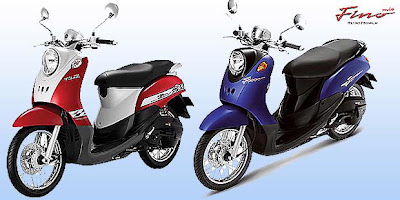
the official price will not be further from the sporty mio price of 13.5 million.
Download User manual here
Thursday, May 2, 2013
The Delectable VTR and Traditional HONDAs